
- We have kittens, please contact us at dirigo3@earthlink.net
Pictures will be e-mailed of our currently available kittens. -
landline 207 893 0415 anytime
Our Maine Coon Kittens are intelligent, lovingly affectionate, health-guaranteed.
The Dirigo pedigree line of Maine Coons truly comes from Maine
and is traditional both in type and disposition. People have said many times that
these were the best cats they ever had, and have come back for another.
They are wonderful companions, sweet-natured, good health is guaranteed
Yes we test and also use DNA, low clones and low top 5. Breeder inquiries accepted depending on your location.
Maine Coons are great cats-highly intelligent- some even play fetch!
They follow you, sit near you or on you, and stay sweet after they grow up.
When you bring a Dirigo Maine Coon into your life, they love you back.
My hobby interest in real Maine Coons resulted in the many internationally
published articles below, to capture the history of this wonderful Maine Breed of cat.
My photos have been published in both "That Yankee Cat the Maine Coon" by Marilis Hornidge
and in "The Maine Coon Cat" by Liza Gardner Walsh.
Kitten Pictures by request
Pictures of the Maine Coon Cat Breed
Request kitten pictures 
For a kitten 

Articles / Publications
Folklore
Health
Links
There is immense personal satisfaction that we get from this hobby in meeting new friends that want a kitten
and in giving and sharing with them the joy, happiness, warmth and affection of a Maine Coon kitten.
A kitten has a special place in this often fast paced life of ours.
Cats are a way of uniting people who would not otherwise meet. Inquiries are welcome. We have 41 Champion cats in CFA, TICA, and CFF. We are registered with CFA, TICA, CFF, and ACFA.
Maine Coons come in about every color.
|
Dirigo can assist in review of pedigrees and guidance for new breeders. The Dirigo bloodline is behind many grand champions. The Dirigo bloodline is recognized world-wide as a strong and healthy bloodline, and is outcross to all other MC lines. As a breeder for nearly 50 years, Dirigo has bred a long list of CFA, TICA, ACFA, CFF and FIFe
pedigreed champions developed from Maine-origin cats

. . . to show standards . . . . . . (www.cfainc.org/breeds/standards/maine.html)
DIRIGO Maine Coons are of Maine-origin. Dirigo has developed the
traditional Maine Coon Cat with the " Mainelook " -a moreshaggy, sweet-faced appearance. Publications:
This site contains 40 web pages about the Maine Coon Cat, its history, legends, folklore, and includes publications by
distinguished author of Dirigo Maine Coon Cats.
Two hundred years ago, Maine Coon cats were simply called "Maine cats." Where ... [more]
These early cats were known as "Maine cats" with the name "Coon" added prior to 1865 (in publications
by a celebrated Maine author ... [more]
The Maine cat developed naturally, out-doors, in the wild, in Maine. Maine is where it developed naturally in local isolation where its gene "pool" was free from external dilution. They developed naturally long before they appeared anywhere outside of Maine ... [more]
The Maine Coon Cat of today flourished and slowly developed the distinctive characteristics uniqueto the breed. The breed could not have developed in Boston, for example, because there would have been too many other cats to dilute the gene pool ... [more]. However, the Bostonian influence can be seen in the polydactyl Maine Coons that still naturally occur ... [more]
Mysteries of the origin of the Maine Coon Cat, folklore and tales, and stories of interest, facts and circumstances surrounding the place and birth of Maine's wonderful native coon cat ... [more]
|
Dirigo is an internationally published author of articles about the Maine Coon Cat and photographer of Maine Coon Cat pictures of the Maine Coon breed, is a historian of MCC legends and tall tails, and is a breeder member and a founder of the Native Maine Coon Cat Association.
Our Association, the Native Maine Coon Cat Association (NMCCA), is dedicated to preserving the native Maine Coon Cat and contributes substantially to history and evolution of the Maine Coon Cat breed, genetic topics, and breeding articles. We are breeders and cat fanciers who show in and support all cat associations.
The History of the Polydactyl Maine Coon: Maine Coons come from Maine and polydactyl Maine Coons most especially show their Maine heritage visibly in their extra-wide, multi-toed paws ... [more]
A fluffy Maine "cooncat": The large, fluffy, semi-longhair, natural domestic cat breed that originated in Maine was called "cooncat" there in the 1800's as documented in ... [more]
Historical article The Saturday Evening Post article about the Maine Coon Cat dated 1901: "At the present time [January, 1901] all of them come from Maine, simply for the reason that the breed is peculiar as yet to that State [in 1900]” ... [more]
... “Coon-cats have been recognized as a distinct breed in Maine for so long that the memory of the oldest inhabitant [known in 1901] runs back to their beginning” ... [more]
The genetic base of the Maine cat was well established in Maine by the late 1700s long before there were any pedigrees, cat breeders, registries, cat clubs or even many people for that matter.
|
The Legend of Rosalind of Squam Island: "Captain Clough sailed up the Sheepscot River to his home on Squam Island; and he brought beautifully carved furniture, draperies of velvet and silk, magnificent paper hangings,and even gowns of costly brocade, [and perhaps cats] which the friends of Marie Antoinette had placed on board his vessel in the far-away French waters" ... [more]
The Legends of Pinepoint: "The barn on the Tarbox farm, near Biddeford Pool, Maine, waswell-populated with beautiful Maine Coon cats, undoubtedly related to" ... [more]
A native Mainer, notable Maine author and artist did her undergraduate studies in fine art and literature at Syracuse University. She has written many articles on this unique breed of cat. Her articles are internationally published and have been translated into other languages since 1990. She has written many of the most authoritative articles about the unique Maine Coon breed.She is internationally recognized as a foremost authority on the Maine Coon breed. She is dedicated to preserving native Maine Coon cats. She contributes substantially to the history and evolution of the Maine Coon Cat breed, genetic topics, and breeding articles about Maine Coon Cats.
She is author of articles for the magazine Maine Coon International. Information and articles are available thru Dirigo.
References:
|
Cat Registry
|
Featured in That Yankee Cat, The Maine Coon by Marilis Hornidge, is our Dirigo Swift River Ruffian, "Ruffie."
Titles are both CFF and TICA. Contacts: 
|
Dirigo 1-207-893-0415 landline |
"Dirigo" is the official motto of the State of Maine.
The official Maine State cat is the Maine Coon Cat.
. . 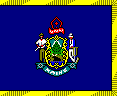
The name Dirigo is recognized by we native Mainers to mean "of Maine" in the common usage and is the official State Motto of Maine.
Copyright Dirigo 1987-2029. Site including Maine Coon Articles, original research in archives, and photographs Copyright Beth Kus 1987-2093
All rights reserved
Revised 06/07/26
Dirigo